Today’s world his highly globalized, and businesses are increasingly turning to AI website translators to make their websites multilingual and accessible to a global audience. These tools leverage the power of artificial intelligence to automate the translation process, saving time and resources while expanding a business’s reach. However, as with any technology, there are pros and cons to using AI for website translation.
What are AI website translators and how do they work?
An AI website translator is a software tool powered by artificial intelligence that automatically translates website content from one language to another. Unlike traditional translation methods, which rely on human translators to manually translate each sentence, AI-based tools use machine learning algorithms to analyze and translate the text.
These systems learn from extensive linguistic data, enabling them to translate content quickly and efficiently. AI website translation tools integrate smoothly with websites, offering real-time translations on all pages. The process is highly automated, which means businesses can keep their websites up to date without worrying about manually revising translations whenever content changes.
The biggest advantage of using an AI website translator is speed. Traditional human translation can be slow and expensive, while AI can translate large volumes of text almost instantly. Still, even as AI tools grow increasingly sophisticated, they have clear limitations, especially when translating nuanced or highly specialized content.
An overview of the most common AI website translators
Several AI website translators are currently available, each offering different features and capabilities. Some of the most widely used options include Google Translate, DeepL, and Microsoft Translator. Here is a closer look at each:
| AI Website Translator | CMS Plugins Available | Translation Quality | Best Supported Languages | Languages with Limitations |
| Google Translate | Yes (via Google Cloud) | Basic translations that often miss nuance or context, which can result in a robotic feel. | 100+ languages, although accuracy may be weaker for niche markets. | Limited regional language support, especially for less common dialects or technical content. |
| DeepL | Yes (via API) | Excellent for European languages, but weaker for non-European languages, which reduces its usefulness for global expansion. | Strong performance in European languages, but coverage is limited for Asian and African languages. | Limited support for languages outside Europe. Requires a complementary tool for global websites. |
| Microsoft Translator | Yes (via Microsoft Azure) | Works well for large volumes, although accuracy often drops in industry-specific or culturally sensitive contexts. | 70+ languages, but not customized for specific markets. | Inaccurate for technical or complex content and lacking cultural nuance in some translations. |
While these tools may perform adequately in some situations, we do not recommend them for professional website localization. Their limitations become significant with specialized or culturally specific content. Google Translate, DeepL, and Microsoft Translator often miss subtleties and cannot consistently deliver accurate translations for certain markets. LS Connectors provides a more dependable option by combining AI with CMS systems to produce precise, culturally relevant translations.
The best solution and the ultimate one: LS Connectors
When choosing AI website translators, the best solution is not simply the most popular or widely used tool. For a truly seamless and efficient translation process, businesses need a solution that integrates AI website translation directly with their existing systems, enabling smooth workflows and high-quality results.
This is where LS Connectors proves essential. LS Connectors is an advanced integration tool that links your content management systems (CMS) with AI website translators. This allows businesses to automate the entire translation process and synchronize translations in all website content, without the need to manually update each page whenever content changes.
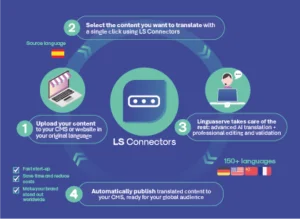
With LS Connectors, businesses can integrate multiple AI website translation tools into one platform and select the best option for each project. This unified approach ensures that translations remain consistent throughout the site and are updated in real time as content evolves, offering a level of efficiency that other solutions simply can’t match.
The strength of LS Connectors lies in its ability to automate the full workflow. For example, when you publish new content on your website, LS Connectors automatically sends the material to the AI website translator, receives the translated version, and uploads it to your site without manual input. This saves businesses considerable time and reduces the risk of human error. In addition, LS Connectors helps maintain SEO optimization by ensuring that translated content is indexed correctly by search engines, which improves global visibility.
By using LS Connectors, businesses can scale their website translation efforts, expand into new markets, and offer a more inclusive experience for their users, all while preserving the quality of the content.