

Going global with a product is rarely a bigger version of a local launch — it’s a different exercise. Markets behave differently, buyers respond to different signals, and the value proposition that wins in Madrid can stall in Frankfurt or fall flat in Chicago.
A serious product launch strategy for international markets combines market intelligence, cultural localization, multilingual SEO, and tightly aligned commercial operations. This guide breaks down the framework, the seven steps, and the patterns that drain launch budgets — written from the angle of a team that has helped brands enter Europe, the United States, and Latin America without losing a quarter to translation chaos.
Key data behind global product launches
- 95% of new products fail within their first year — the figure Clayton Christensen popularized at Harvard Business School and that still anchors most launch postmortems.
- 76% of consumers prefer to buy products with information in their own language, according to CSA Research’s Can’t Read, Won’t Buy studies.
- 40% of consumers will not buy from websites in other languages — same source, and a number that climbs higher in regulated sectors.
- Localized landing pages outperform English-only equivalents by 30% to 50% in conversion in B2B contexts (Nimdzi industry estimate, 2024).
What Is a Product Launch Strategy?
A product launch strategy is the plan that connects product readiness with market entry. It defines the objective, the audience, the messaging, the channels, the pricing, the supporting content, the internal coordination, and the metrics that decide whether the launch worked. It’s the difference between dropping a product on the market and orchestrating its arrival.
For a single market, that strategy can fit in a Notion doc. For multiple markets at once, it becomes a layered operation — regional positioning, language assets, local partners, regulatory checks, payment infrastructure, customer support across time zones that span twelve hours. Treating it as a bigger version of your domestic launch is the first mistake.
Local vs. global product launch — key differences
A local launch reuses one set of assumptions: the buyer persona, the cultural references, the pricing logic, the legal frame, the distribution map. A global launch breaks every one of those assumptions per country. What is “premium” in one market is “mid-tier” in another. A 30% discount reads as generous in Italy and suspicious in Switzerland. Trust signals that work in the US — customer reviews, big logos, founder-led storytelling — carry less weight in markets where peer recommendations and trade press matter more.
The operational gap is where most launches stumble. Producing one campaign in one language is a project. Producing the same campaign in eight languages with regional adaptations, native voice, legal compliance, and consistent SEO across all of them is a program — and one that doesn’t tolerate amateur execution.
Why international launches require a different approach
Time-to-market gets compressed. You’re not just shipping a product; you’re shipping a product, a website, support documentation, a paid acquisition strategy, a content engine, and a sales script — all multiplied by the number of countries. If your launch window is six weeks, every day spent fixing a botched translation is a day lost in a competitive race.
Risk concentration also changes. A misstep in your home market is recoverable. A misstep in a launch market often means you don’t get a second chance. Local press picks up the failure, the early adopters move on, and reacquiring them is far more expensive than acquiring them. This is the structural reason why localized messaging isn’t a marketing decoration — it’s a risk management function.
Product Launch Strategy Framework — Building the Right Foundation
A framework isn’t a checklist. It’s the architecture that lets your team make decisions consistently across markets without escalating every choice to headquarters. The right product launch strategy framework answers four questions clearly: what problem does this product solve, and how does that problem look in each market? Who is the buyer, and what’s their decision process? How will we reach them, and how will we measure that reach? What does success look like at 30, 90, and 180 days?
Core components every framework needs
Five components are non-negotiable. Market intelligence — what does demand actually look like beyond search volume? Positioning — how do you compete against incumbents and substitutes? Messaging architecture — which arguments per market and per persona? Channel mix — paid, organic, partnerships, sales-led, in what proportion? Measurement model — KPIs, attribution windows, review cadence.
The most common gap is the messaging architecture. Teams build a single brand narrative, translate it, and call it a launch. That gives you a deck. It doesn’t give you arguments that work in a sales call in Milan or a procurement meeting in Stuttgart. The framework only delivers value if it forces every market team to write down the three reasons a local buyer would choose your product over the alternative — in their language, with their proof points.
How to customize the framework for your sector
A framework for a SaaS launch in Europe looks different from a fashion ecommerce launch in the US. SaaS launches are anchored in technical credibility, integrations, and security certifications. Fashion launches lean on brand storytelling, influencer ecosystems, and visual identity. Pharma launches start with regulatory compliance and end with HCP education. Industrial launches often go through trade shows and distributor networks before they ever touch a paid campaign.
The structure stays — the inputs change. A framework that ignores sector specificity becomes a generic template that nobody on the ground actually uses.
B2B vs. B2C — adapting your launch model
B2C launches are about volume, emotion, and speed. You need to reach a lot of people, fast, with a memorable story. Cultural and linguistic precision matter because the buyer decides in seconds and forgives nothing.
B2B launches are about specificity, trust, and pipeline. You need to reach the right people, repeatedly, with arguments that survive a six-month sales cycle. Cultural and linguistic precision matter because a misformed sentence in a contract or a security questionnaire can cost you a deal.
The asset stack differs. The discipline is the same — local relevance over global uniformity.
Why Launch Strategies Change According to Culture
Culture isn’t decoration. It’s the operating system the buyer uses to interpret your offer. Two markets can speak the same language and still respond to opposite arguments — see UK vs. US English-speaking markets, where directness, humor, and authority cues differ enough to produce 20% to 30% gaps in landing page conversion for the same product.
Language is not just translation — it’s positioning
The literal translation of powerful results into Spanish (resultados potentes) sounds aggressive in a B2B context where resultados consistentes y medibles lands better. The English we move fast translates technically into French but reads as careless to a buyer who values rigueur. Each language carries its own register, and the register signals where you fit in the market.
This is why machine translation alone — even the best models — fails at the top of the funnel. The output is grammatical. It’s just not persuasive. Linguaserve’s Quality Estimation approach addresses exactly this gap: it identifies which segments of AI-translated content can ship as is and which need a human linguist to fine-tune the persuasive layer. The result is faster turnaround on bulk content and tighter quality on the assets that actually drive conversion.
How cultural values shape buying decisions
Hofstede’s cultural dimensions still hold up in B2B research. High uncertainty avoidance markets — Germany, Japan, Switzerland — mean buyers want detailed specifications, certifications, references before they engage. High individualism markets — US, UK, Netherlands — respond to personal benefit and ROI framing more than to collective references. Long-term orientation markets — Korea, China, parts of Southern Europe — expect relationship-building before the sale.
These dimensions affect everything from email frequency to webinar length to the structure of your case studies. A US-style 30-minute demo gets cut to 15 in the Nordics and stretched to 60 in Japan with introductions, deference, and context-setting. Same product, three different choreographies.
Regional differences to consider before launching
Pricing display — VAT-inclusive in Europe, exclusive in the US. Payment methods — SEPA across Europe, ACH in the US, Bizum in Spain, iDEAL in the Netherlands, PIX in Brazil. Privacy frameworks — GDPR in EU/UK, CCPA in California, LGPD in Brazil. Customer service expectations — 24-hour response is standard in the US, one-hour in some Nordic B2B contexts. Each detail looks small. Together they decide whether your local site feels native or foreign.
Europe vs. USA — what changes in your strategy
In the US, speed wins. Launch fast, iterate publicly, optimize after. Channels are dominated by paid search, programmatic, and creator-led social. Sales cycles compress; deals close on momentum.
In Europe, trust wins. Launch carefully, prove the case with local references, optimize quietly. Channels mix paid, organic, trade press, and partnerships. Sales cycles run longer because procurement, legal, and compliance get involved earlier. The same product needs two operating systems — and the team that builds both gets disproportionate returns.
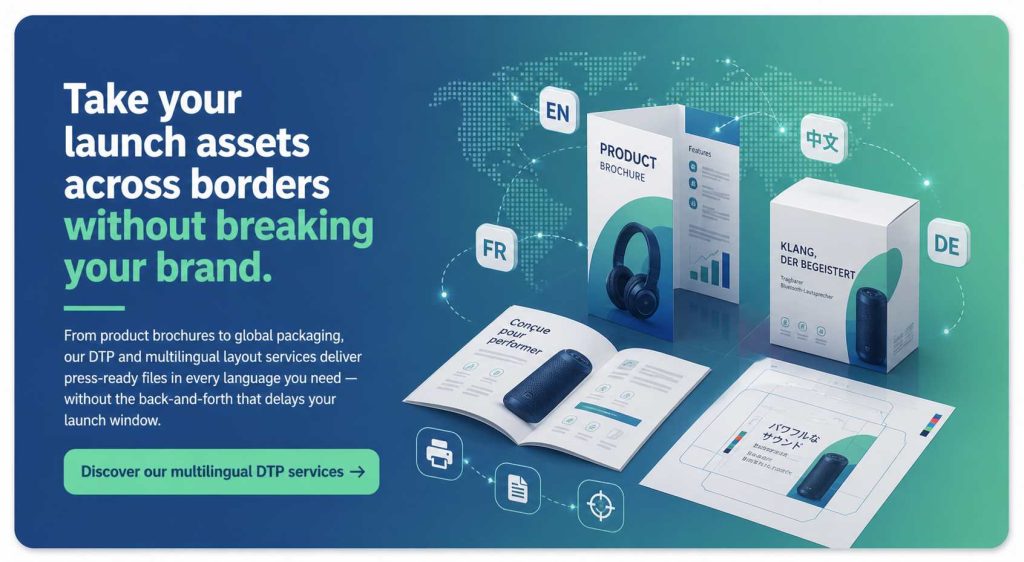
Take your launch assets across borders without breaking your brand.
From product brochures to global packaging, our DTP and multilingual layout services deliver press-ready files in every language you need — without the back-and-forth that delays your launch window.
The 7 Steps to Launch Your Product in Global Markets
These seven steps assume you already have product-market fit at home. International expansion magnifies whatever exists — including weak fundamentals. Skipping a step shows up later, usually in a board meeting where someone asks why CAC tripled in market three.
Step 1 — Set clear goals and KPIs
Define what success looks like in each market and per phase. Pipeline targets at 30, 90, and 180 days. CAC ceilings per channel. Conversion rates per asset type. Without explicit numbers, your team will optimize for activity instead of outcome.
For a B2B SaaS entering France, a realistic 90-day target might be 200 qualified meetings, CAC under 2x payback target, 10% of pipeline converted to paid pilots. Specific, measurable, debatable — that’s what a useful KPI looks like.
Step 2 — Research your target market and audience
Quantitative first — market size, competitor pricing, search demand, channel maturity. Qualitative next — eight to twelve interviews per market with target personas. The qualitative layer is where most teams skip and pay for it later.
If you can’t articulate the buyer’s day, the buyer’s three biggest frustrations, and the buyer’s preferred information channels, you don’t know the market well enough to launch in it.
Step 3 — Build your localized messaging
This is where website localization services for your business become a strategic asset, not a checkbox. The site, the ads, the emails, the sales decks — every asset adapted, not just translated. Voice and tone calibrated per market. Proof points selected per market. Calls to action phrased per market.
For ecommerce in fashion and luxury, this also means product descriptions that respect each market’s lexicon. A blazer in the US, a veste de tailleur in France — the cut, the styling cue, and the cultural reference shift the buyer’s mental image. A literal translation loses that specificity, and with it, the conversion.
Step 4 — Define your go-to-market channels
Channel mix is not a copy-paste exercise. LinkedIn dominates in northern Europe; in Italy and Spain, in-person events and industry associations carry more weight. In the US, podcast advertising scales B2B brands faster than in Europe, where podcast adoption is still uneven by country.
For paid search, CPC variance between markets can exceed 4x for the same keyword set. Budgeting per market — not globally — is what protects margin. The team that allocates one bucket of budget across “Europe” without country breakdowns burns 30% of it on traffic that never converts.
Step 5 — Align your internal teams and local partners
A launch that depends on a single overworked product marketer in HQ rarely succeeds. You need a clear RACI per market, local champions where possible, and external partners — PR, agencies, legal counsel, language partners — selected before the launch sprint, not during it.
This is where many teams underinvest in their language partner. Treating translation as procurement extends timelines and degrades quality. Treating it as a strategic capability — with a partner embedded in the launch team from week one — accelerates everything downstream.
Step 6 — Run a phased rollout with a feedback loop
Don’t launch everywhere on day one. Pick a beachhead market, validate the playbook, then expand. The phased approach gives you signals to correct messaging, channel mix, and pricing before you scale the burn rate.
A real feedback loop means weekly sync between local teams and HQ, dashboards visible to both, and a willingness to revise the plan in week three instead of waiting for the postmortem. Most launches gather data; few act on it fast enough to matter.
Step 7 — Measure, iterate, and scale
Three layers of measurement deserve separate attention. Campaign metrics — impressions, clicks, conversions. Pipeline metrics — MQLs, SQLs, opportunities, revenue. Brand metrics — aided and unaided awareness, share of voice in target accounts.
Iteration is where the launch becomes a program. The first 90 days produce data; the next 90 days act on it. Markets that get treated as one-off launches lose to markets that get treated as ongoing investments. Scaling without iteration is just multiplying the original mistakes.
Key Elements of a Global Launch Campaign
The campaign is the visible layer. Underneath it sits the operational stack — content, SEO, PR, sales enablement — that decides whether the campaign delivers pipeline or only impressions.
Content localization and multilingual SEO
Multilingual SEO isn’t translated SEO. Search behavior differs per market — Germans use longer compound terms, French searches lean on questions, Japanese searches mix kanji and English brand names. Keyword research has to start fresh in each market, not derived from a translated glossary.
Hreflang implementation, country-specific domain or subdirectory choice, local backlinks, and localized schema markup are the technical baseline.
The content layer — articles, product pages, comparison pages — is where the differentiation lives. International SEO strategies for businesses that ignore intent variance per market end up ranking for terms that don’t convert. Visibility without intent match is a vanity metric.
International PR and media strategy
Local press still drives credibility, especially in B2B. A mention in Les Echos, Handelsblatt, Il Sole 24 Ore, or specific trade publications opens doors that paid media doesn’t. The investment is editorial — you need a story angle that resonates locally, spokespeople comfortable in the local language, and a press kit that doesn’t read as translated.
For regulated sectors — pharma, finance, defense — PR is also where regulatory positioning gets shaped. A misformed quote in a French regulator’s interview is a longer-lasting problem than a misformed ad.
How to choose the right languages for your launch
Don’t default to “the big five.” Pick languages that match revenue potential, competitive density, and operational capacity. For a B2B launch in Europe, English plus French and German often delivers 70% of addressable revenue. For consumer-facing launches, you may need Italian, Spanish, Dutch, and Polish before you see traction.
A useful filter — rank target markets by expected 12-month revenue, then by cost of localization (content volume × frequency × specialization). Languages where revenue potential exceeds localization cost by 5x are clear yeses. The rest deserve a phased approach with a tighter scope.
Product Launch Strategy Template — A Practical Starting Point
A workable product launch strategy template includes ten sections — launch objective, target markets, buyer persona per market, value proposition per market, messaging matrix, asset list per market, channel plan per market, timeline (T-90 to T+90), KPIs and review cadence, and risk register.
Don’t build a 60-page document. Build a 12-page operational playbook the team will actually use. The longer the template, the lower the adoption.
A practical exercise — fill the template for your strongest market first, then duplicate and adapt. Most teams discover that 60% of the structure is reusable, 30% needs adaptation, and 10% is fully market-specific. That ratio is your localization workload, expressed in numbers your CFO can budget against.

New Product Launch Examples That Worked Across Markets
Three patterns recur in new product launch examples that actually scaled across borders.
Pattern one — the localized hero brand. A European luxury fashion house entering the US repositioned its catalog with US-specific styling references, US-sized photography, and a US-priced freight model. Same products, fully relocalized digital experience. Conversion in the US matched the European benchmark within nine months — not because the product changed, but because the buyer recognized themselves in the experience.
Pattern two — the technical credibility play. A Spanish industrial automation company entering Germany invested six months in German technical content, white papers, and trade show presence before opening a sales motion. The slow build paid off — by month twelve, inbound qualified leads from Germany matched Spain. The launch looked late externally and disciplined internally.
Pattern three — the regulatory beachhead. A pharma company launching a new device in the EU sequenced the launch by approval timing, leading with the country where the regulatory pathway moved fastest, then using that reference in subsequent markets. The sequence mattered more than the speed. Each approval became a proof point for the next.
What ties these together — none of them treated localization as a vendor task. All three integrated language and cultural expertise into the launch team itself. The teams that get this right build a repeatable playbook. The teams that don’t relaunch from scratch in every market.
Common Mistakes When Launching in New Markets
The patterns that drain launch budgets are predictable, and most of them come from treating expansion as a marketing project instead of an operational program.
Translating instead of localizing. The website, ads, and emails are linguistically correct and commercially flat. The buyer doesn’t recognize themselves in the copy, and the conversion rate quietly underperforms the home market by 40%.
Launching in too many markets at once. Resources spread thin, no market gets enough attention, signals from each market get muddied, and the team can’t tell which playbook is working. Three markets done well beats eight markets done halfway.
Underinvesting in local talent. A native speaker reviewing copy is not a luxury. It’s the cheapest insurance against a six-figure media spend on flat creative. The teams that skip this step pay for it twice — once in wasted media, once in re-translation.
Skipping legal and regulatory checks. Especially in pharma, finance, defense, and food. A launch that violates local advertising rules or labeling requirements gets pulled. The cost of pulling is always higher than the cost of checking, and the reputational damage outlasts the campaign.
Treating translation as a cost center. The teams that treat language as a strategic capability — with proper QA, terminology management, and validation layers like Linguaserve’s Quality Estimation — produce assets that convert better and require less rework. The teams that treat it as procurement spend more by year-end and get less in return.
Ignoring post-launch optimization. The first version of your localized messaging is rarely the best version. Without a structured iteration loop — A/B testing, feedback from sales calls, search behavior data — you ship the launch and never improve it. Markets that get optimized monthly outperform markets that get optimized annually by an order of magnitude.
Frequently Asked Questions About Global Product Launches
How long does it take to launch a product in a new international market?
A serious international launch takes between four and nine months from kickoff to public availability, depending on sector and market complexity. SaaS launches in English-speaking markets can compress to three or four months. Pharma, defense, and finance launches with regulatory dependencies routinely run nine to eighteen months. The two factors that drive the timeline are regulatory pathway and asset localization volume, not marketing readiness.
What’s the difference between translation and localization in a product launch?
Translation converts text from one language to another while preserving meaning. Localization adapts the entire experience — copy, imagery, examples, currency, payment methods, legal disclaimers, cultural references — so the buyer perceives the product as built for their market. Translation answers the question what does this say? Localization answers the question does this feel local? A product launch needs the second, not just the first.
How much should a company budget for a global product launch?
Localization typically represents 5% to 15% of the total launch budget per market, depending on sector and asset volume. Total launch budgets vary widely — a B2B SaaS launch in three European markets might run from 250,000 to 800,000 euros across media, content, events, and localization. Industrial and pharma launches can exceed 2 million euros once regulatory work, trade shows, and sales enablement are included. The benchmark that matters is CAC payback, not absolute spend.
What languages should a B2B company prioritize for European expansion?
For most B2B companies, English plus German and French covers 60% to 70% of addressable European revenue. Adding Italian and Spanish lifts that to 80%. Dutch, Polish, and Nordic languages become relevant for specific verticals — fintech, logistics, and ecommerce in particular. The decision should follow revenue potential per language and the maturity of buyers in that language, not symbolic coverage.
How does AI translation fit into a serious product launch strategy?
AI translation, used well, accelerates bulk content — knowledge bases, support documentation, product catalogs — at a fraction of traditional cost. It fails on high-stakes assets where persuasion, tone, and legal precision matter. The mature approach combines AI for volume with human validation for impact assets. Linguaserve’s Quality Estimation model identifies exactly which segments need human review, so teams capture the speed of AI without the conversion penalty.
When should I involve a localization partner in the launch process?
From day one of launch planning, not after creative is finalized. A localization partner involved during messaging design will flag cultural mismatches, terminology gaps, and SEO opportunities before they become rework. A partner brought in at the asset-handoff stage can only execute on decisions already made — most of them suboptimal for the target market. Early involvement typically reduces total localization spend by 20% to 30% across the launch.
Turning Your Global Launch Into a Repeatable Operation
A great launch in one market is a result. A great launch playbook across multiple markets is a competitive advantage that compounds with every expansion. The companies that win in international markets aren’t the ones with the biggest budgets — they’re the ones that built the muscle to translate strategy into local execution without losing fidelity.
That muscle is part process, part technology, part partnership. Linguaserve sits at the intersection of all three. The Quality Estimation engine decides which AI-translated content can ship as is and which needs human linguists, so you ship faster without compromising on the assets that drive conversion. The LISA workflow combines AI throughput with human validation.
The international marketing layer covers customer acquisition strategies for international markets — multilingual SEO, paid media adaptation, content programs — so localization connects directly to pipeline. And the sector experience in ecommerce, fashion and luxury, industry, pharma, finance, and defense means the team understands the constraints before you have to explain them.
If you’re planning a launch in Europe, the US, or Latin America in the next six months, the conversation worth having now is about scope, sequence, and the assets that will move the needle. Everything else follows from that.