

At Linguaserve, we provide accessible solutions for web and mobile platforms that comply with global standards and improve the user experience. Our web accessibility services help organizations ensure that people of all abilities can reliably and independently use their digital platforms. We work with public institutions, private companies, and international organizations to websites and apps accessible, compliant, and practical to use in real conditions.
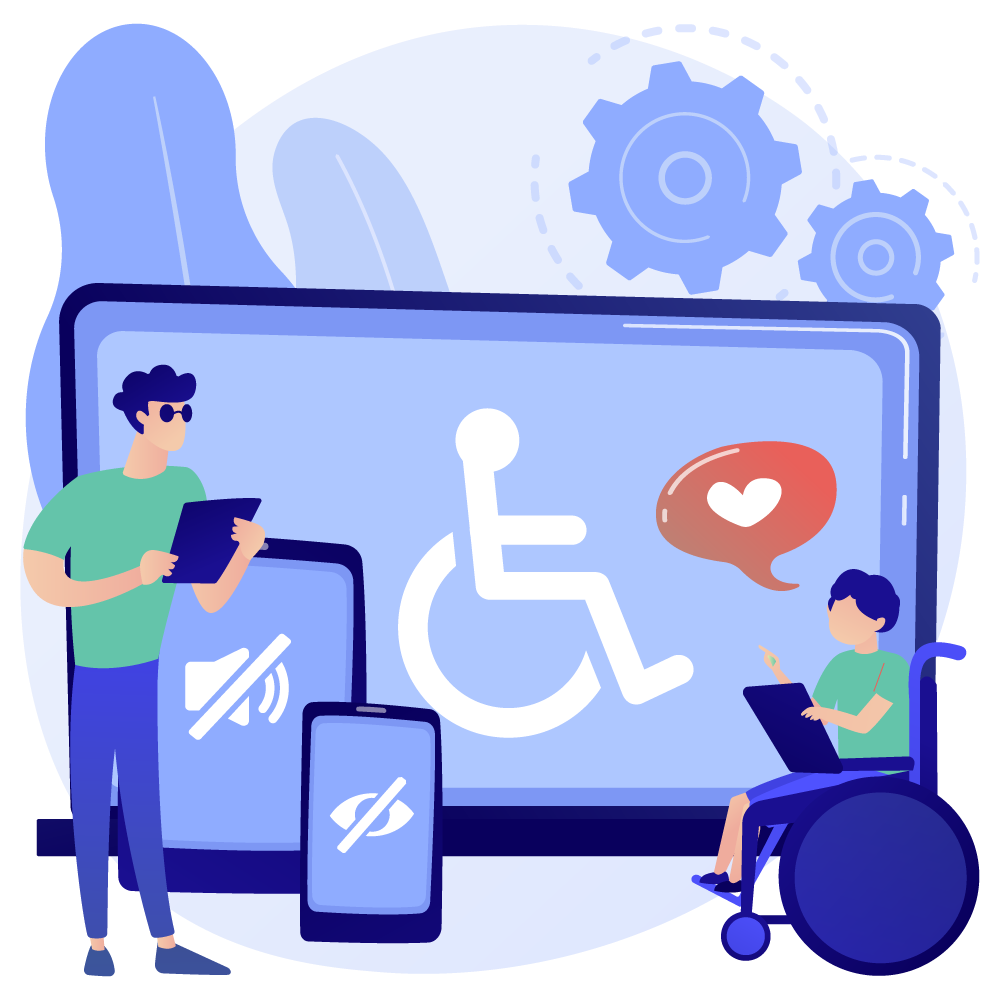
Accessibility should be approached as a practical design responsibility, not just a regulatory obligation. It involves understanding how people with disabilities actually interact with digital content and making sure those interactions work as intended. Our web accessibility services focus on removing barriers that prevent users from navigating, understanding, or completing tasks on websites and apps.
We help organizations align their digital platforms with recognized standards such as UNE-EN 301549:2022, while also improving everyday usability. This applies equally to websites and mobile apps. Rather than relying on generic fixes, we tailor each accessibility solution to the specific technologies, content structures, and user journeys involved.
At Linguaserve, accessibility is treated as part of overall digital quality. Our services cover audits, remediation, accessible development, training, testing with real users, and support for official certification aligned with the European Union’s accessibility directive. The objective is straightforward: to ensure that digital content works properly for a diverse range of users and remains compliant as technologies and standards evolve.

Web accessibility refers to the practice of designing and maintaining digital platforms so that they can be used by everyone, including people with disabilities. This means users with visual, auditory, motor, cognitive, or neurological impairments, as well as those who rely on assistive technologies such as screen readers, keyboard navigation, voice recognition software, or alternative input devices.
An accessible website allows users to perceive information clearly, navigate content efficiently, and interact with functions without unnecessary obstacles. Accessibility also benefits people with temporary limitations, age-related changes, or situational constraints such as using a device in bright sunlight or without sound. In practice, accessibility improves clarity, consistency, and structure, which benefits all users, not only those with disabilities.
Web accessibility matters because digital services have become essential. People use websites and apps to access public services, manage finances, work, learn, and communicate. When digital platforms are not accessible, entire groups of users are effectively excluded.
There is also a clear legal dimension. Accessibility regulations at national and international levels require many organizations to meet defined standards. Non-compliance can lead to legal challenges, reputational risk, and loss of trust. Addressing accessibility proactively helps organizations meet their obligations with confidence.
Beyond compliance, accessible platforms tend to perform better overall. They are easier to navigate, clearer to understand, and more resilient across devices and technologies. Accessibility also supports corporate responsibility goals and demonstrates a concrete commitment to inclusion, which increasingly influences how customers, partners, and employees perceive organizations.

Accessibility audits provide a detailed assessment of how a website or application performs against established standards such as UNE-EN 301549:2022 and applicable WCAG criteria. Audits combine automated testing with expert manual review to identify issues that tools alone cannot detect.
This process examines navigation, content structure, color contrast, form behavior, multimedia elements, and compatibility with assistive technologies. Findings are documented clearly, with practical recommendations prioritized by impact and effort. The result is a realistic action plan rather than a theoretical checklist.

Long-term accessibility depends on informed teams. Linguaserve offers specialized training for designers, developers, content authors, and project managers. Training focuses on practical scenarios and real examples, helping teams understand how accessibility requirements apply to their daily work.
These sessions support ongoing compliance and reduce the risk of accessibility issues being reintroduced as content and features evolve. Training can be adapted to different roles, technical levels, and organizational contexts.
Accessible development integrates accessibility requirements directly into code, components, and design systems. We work with development teams to ensure that websites and apps support keyboard navigation, semantic structure, proper labeling, and compatibility with assistive technologies.
This approach improves stability and reduces long-term remediation costs. Accessibility is treated as part of normal development practice, not as an afterthought or separate layer.

Many organizations rely on digital documents alongside their websites. We create accessible documents, including PDFs and other formats, which can be navigated and read using assistive technologies. This includes proper tagging, logical reading order, descriptive text for images, and consistent structure.
Accessible documents ensure that users receive the same information and functionality regardless of how they access content.

For organizations that require formal validation, we provide support throughout the accessibility certification process. Certification is based on recognized standards such as UNE-EN 301549:2022 and related frameworks.
Achieving certification demonstrates compliance and transparency, which is particularly important for public sector bodies and organizations operating in regulated environments.

Testing with real users is essential to understanding how accessibility works in practice. We involve people with disabilities to test websites and apps in realistic usage scenarios.
Their feedback highlights issues that may not appear during technical reviews and helps ensure that accessibility improvements reflect genuine user needs rather than theoretical assumptions.
Accessibility services support digital inclusion by ensuring that information and services are available to everyone. Inclusive platforms allow users to engage independently and with confidence.
Aligning with accessibility standards reduces legal risk and supports compliance with applicable regulations. Clear documentation and structured processes also make compliance easier to demonstrate.
Accessible design improves usability for all. Clear navigation, readable content, and predictable interactions make digital platforms easier to use and more efficient.
Addressing accessibility reflects a broader commitment to responsible digital practice. It shows that inclusion is treated as a practical consideration rather than a symbolic gesture.
Accessibility must function in all languages and regions. Linguaserve combines accessibility expertise with linguistic and cultural adaptation to ensure that multilingual websites remain accessible and consistent in every market.
Web accessibility continues to evolve alongside digital technologies. Linguaserve monitors these changes closely to ensure that our web accessibility services remain effective and relevant.
Artificial intelligence is increasingly used to support accessibility tasks such as content analysis and image description. When applied carefully, AI can improve efficiency and scale, while still relying on expert oversight to ensure accuracy and relevance.
Voice interfaces are becoming more common through digital assistants and smart devices. Designing accessible voice interactions requires attention to clarity, structure, and context so that users can complete tasks reliably.
AI-based auditing tools allow organizations to monitor accessibility continuously as content changes. Combined with expert review, they support ongoing compliance and faster problem detection.

Both aim to ensure that people with disabilities can use digital content independently. Web accessibility focuses on websites and browser-based platforms, while mobile app accessibility addresses native applications on smartphones and tablets. Each environment has specific technical requirements, interaction patterns, and assistive technologies.
We start with a comprehensive accessibility audit that combines automated testing, expert analysis, and user testing. Based on the findings, we align your website with standards such as UNE-EN 301549:2022 and relevant WCAG guidelines. We then support remediation, validation, and documentation to ensure both compliance and practical usability.
Yes. We ensure that accessibility is preserved in every language by adapting structure, navigation, and language-specific elements. This enables users in different regions to access content with the same level of clarity and functionality.
We offer role-specific training for design, development, content, and quality teams. Training focuses on practical implementation and ongoing maintenance, helping organizations integrate accessibility into everyday processes.
Accessibility requires continuous attention. Regular audits, staff training, and updates aligned with new technologies and standards are essential. Embedding accessibility into governance and development workflows helps maintain compliance over the long term.
Common issues include navigation that cannot be used with a keyboard, insufficient color contrast, missing or inaccurate alternative text for images, poorly labeled form fields, and multimedia without captions or transcripts. Addressing these issues significantly improves accessibility and usability.
Accessible websites use clear structure, descriptive headings, meaningful links, and alternative text, all of which help search engines understand content more effectively. This often results in improved visibility and search performance.
Accessibility and usability are related but distinct. Accessibility ensures that everyone can use a website, including people with disabilities. Usability focuses on making that experience efficient and intuitive. Effective digital platforms address both.
Yes. By reducing barriers and friction, accessible websites make it easier for users to complete actions such as purchases or registrations. Clear structure and accessible forms support higher engagement and improved conversion rates.